Meta’s New AI Advertising Tools for 2026 that Every Small Business Owner Should Know About
If you’ve been running Facebook ads for more than a year and something has felt off lately, your old targeting stacks underperforming, broad audiences suddenly crushing your laser-focused ad sets, campaigns you would have paused actually finding their footing, you’re not imagining it. Meta didn’t just add some AI features. They rebuilt the entire infrastructure underneath your campaigns.
Here’s what changed, what it means operationally, and what you need to adjust right now:
The Three Engines Running Your Ads Now
To understand everything else, you need to know these three systems. They work together, and they’ve quietly replaced most of what you thought you knew about how Meta delivers ads.
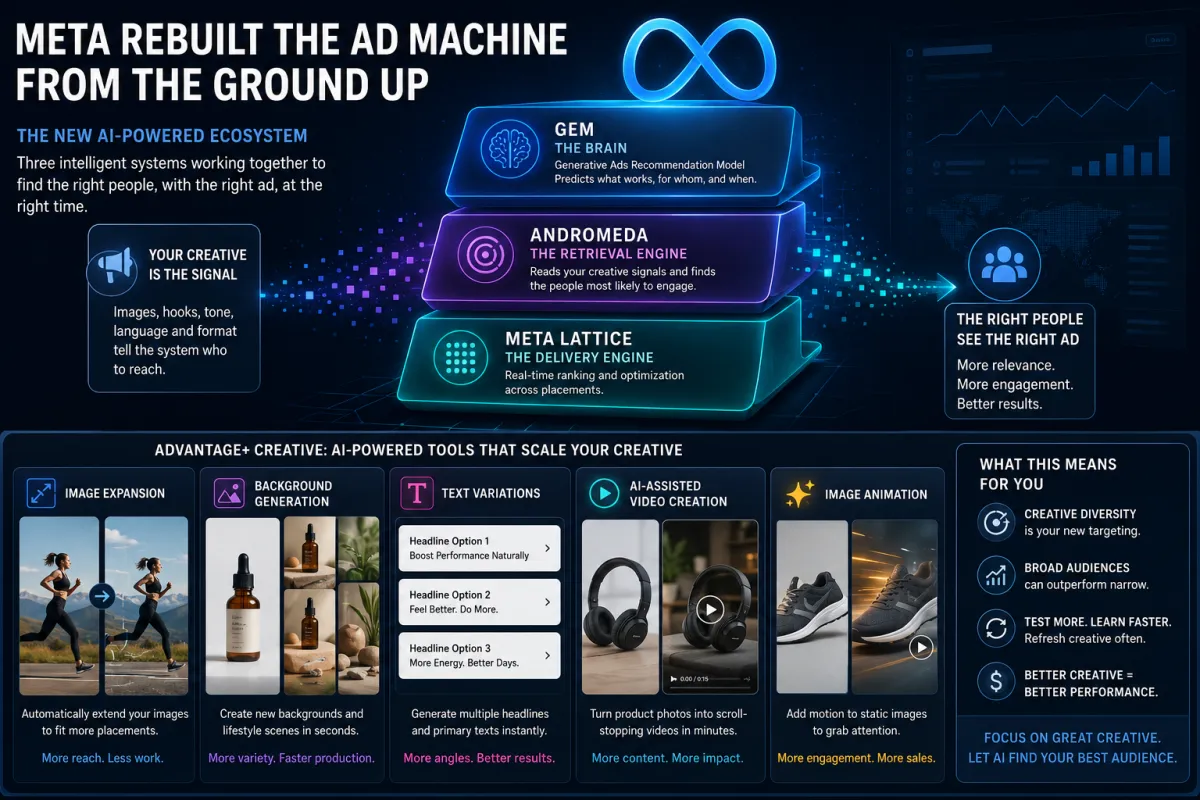
Andromeda is Meta’s new ad retrieval system, and it’s the most consequential change most advertisers never read about. The old system evaluated ads against pre-defined audience pools. You told Meta who to target, and Meta found ads for those people. Andromeda flips that logic. Instead of starting with advertiser-defined audiences, it works in reverse by evaluating your historical engagement, ad copy, creative, and format first, then predicting which users are most likely to engage and contribute to your campaign goals. Your creative is now the targeting signal. The image, the hook, the tone, the language, Andromeda reads all of it and uses it to find the right people. The result: you’re no longer buying access to audiences. You’re buying algorithmic distribution based on creative signals.
GEM (Generative Ads Recommendation Model) is Meta’s large-scale AI that acts as the platform’s central intelligence. GEM leverages enhanced training scalability that efficiently utilizes thousands of GPUs, and it’s already driving significant increases in ad conversions across Instagram and Facebook. In November 2025, GEM boosted Instagram conversions by 5% and Facebook Feed conversions by 3%, and when paired with Advantage+ creative features, led to a 22% increase in ROAS. More importantly, GEM feeds predictions into Andromeda, helping predict what works best, for whom, and when, at scale, while continuously learning. It’s the brain. Andromeda is the retrieval engine. Together they decide which of your ads gets shown and to whom.
Meta Lattice rounds out the trio, handling real-time ranking and delivery optimization across placements. In the current ecosystem, Meta doesn’t just show an ad. It moves it through a high-speed assembly line. Understanding where Andromeda, GEM, and Lattice sit explains why creative diversity is the only reliable way to scale right now.
What This Did to Your Campaigns in Practice
Meta stated explicitly: “With AI-enabled advertising tools, the focus has shifted from niche targeting to creative diversification as the best lever to find relevant audiences.” For media buyers who built their entire playbook around interest stacking, lookalike exclusions, and surgical audience segmentation, that sentence should have set off alarms.
The practical effects that showed up in accounts throughout 2025:
Broad targeting started beating narrow targeting. Campaigns using Advantage+ Audience or open targeting (18–65+, no interests) began delivering better ROAS than precisely segmented campaigns. That went against a decade of Facebook ads best practices, and a lot of advertisers resisted it until their numbers forced the conversation.
The “6 ads per ad set” rule is gone. Meta recommended no more than 6 ads per ad set for years. In 2025, that guidance vanished without announcement, because Andromeda doesn’t pick a winning ad. It matches different ads to different people based on predicted response. To do that effectively, it needs options. Top advertisers now run 15 to 50 ads per ad set. Not 15 variations of the same concept, but 15 genuinely different approaches.
Creative fatigue accelerated. Because the system is now burning through your creative assets faster, matching them across a broader audience pool and across placements, you need a faster refresh cadence than you did two years ago.
Advantage+ Creative: The Tools, Feature by Feature
This is where most of the advertiser-facing change lives. Meta’s generative features under Advantage+ Creative and Meta AI Studio allow you to generate visuals at scale, test different ad variations, and move through the campaign creation journey much faster.
Here’s what’s actually inside it:
Image Expansion generates additional pixels so your image can fit various aspect ratios and be used in more placements. It delivers to Instagram Feed, Facebook Reels, Mobile Feed, Instagram Reels, and Instagram Stories. The practical use case: upload one square creative and let AI adapt it for Reels and Stories without a separate production pass. Watch out for lifestyle shots with people near the frame edges, as AI-generated extensions can look artificial on complex backgrounds.
Background Generation lets you upload an image featuring a particular object and the generative AI creates different background options. You can also generate full images inspired by an existing one, with similar colors, layouts, and optional text overlays. For e-commerce and catalog ads especially, this is a genuine production time-saver. One product shot on white can become five different lifestyle contexts in minutes.
Text Variations generate multiple versions of your primary text and headlines based on your original copy. Different CTAs, different value angles, different tones. The caveat experienced media buyers need to know: if brand voice is critical to your client, preview every variation before it goes live. Meta’s copy can be technically correct but tonally off.
AI-Assisted Video Creation transforms up to 20 product photos into polished, multi-scene video ads with animations, text overlays, and music. No external production team required. This effectively removes the cost barrier to video advertising for accounts that have always relied on static creative.
AI Dubbing and Translation allows multilingual creative at scale with AI-generated voiceovers and AI translation for voiceovers, without re-recording.
Persona-Based Image Generation, rolled out at Advertising Week 2025, generates creative visuals matched to audience characteristics rather than serving one static image to everyone.
Brand Consistency Kit lets you upload your brand kit including logos, colors, and fonts, and the system applies them automatically across all AI-generated creative variants. This directly addresses the biggest objection to AI-generated ads at the agency level: loss of brand identity.
One real-world warning that Meta’s pitch decks won’t include: True Classic had AI enhancements turned on without intending to, and Meta generated images featuring a product the brand doesn’t even sell. These tools are on by default in many campaign setups. Build a pre-launch review step into your workflow. Check every enhancement toggle before you publish.
Opportunity Score: Meta’s New Performance Health Check
Meta rolled out a 0 to 100 scoring system inside Ads Manager that evaluates your campaign setup across four dimensions: creative variety, signal quality (Pixel and Conversions API configuration), audience breadth, and conversion event accuracy.
Early results show advertisers who follow the score’s recommendations see a 12% median decrease in cost per result. Whether you trust it or not, it’s a useful diagnostic tool, especially for auditing accounts you’ve inherited. A low score on signal quality usually means a broken or under-configured Pixel or Conversions API, and that’s killing your campaign optimization before your creative ever gets a chance to work.
Advantage+ Leads: The Expansion That Changes the B2B Service Business Game
Meta rolled out a new wave of AI-driven updates specifically for lead generation. Advantage+ Leads Campaigns are now available globally. Meta is also testing an automated lead engagement feature that lets advertisers promptly connect with a lead on Messenger, plus two new lead verification tools: SMS by phone number and Work email verification.
For service businesses, coaches, consultants, and anyone running lead gen rather than e-commerce, this is the most significant Advantage+ expansion of the past two years. Meta’s early testing shows Advantage+ Leads campaigns reduce cost per qualified lead by 10%, and the same automated engine that e-commerce brands have been leveraging since 2023 is now fully available for the lead generation funnel.
What You Need to Stop Doing Right Now
The old playbook actively works against the new system. Some specific behaviors that are now costing you performance:
Stop micromanaging audiences. Interest stacking and hyper-specific targeting are now more likely to constrain the algorithm than help it. Give the system room to find your buyers. Your creative is your targeting now.
Stop running 3 to 5 ads per ad set and calling it testing. The system needs diversity, genuinely different hooks, different visual styles, different emotional angles. If all your ads share the same concept but differ by color or one line of copy, you’re not giving Andromeda enough signal variety to do its job.
Stop leaving Advantage+ Creative on default without reviewing. It’s powerful, but unsupervised it will make brand decisions you didn’t authorize. Enable it strategically, preview everything, and disable individual enhancements that don’t match your brand standards.
Stop ignoring your Pixel and Conversions API configuration. Meta has emphasized strong parity between CAPI and Pixel as a critical step to improve match rates and campaign effectiveness. If your signal quality is weak, the AI has bad data to learn from. Garbage in, garbage out is still a very valid rule. The Opportunity Score will tell you exactly where your setup is leaking.
Where This is All Going
Meta has signaled that by late 2026, advertisers may only need to provide a goal, a budget, and a single product image, with Meta’s AI building everything else. Already, you can provide a product URL, a budget, and a basic prompt and GEM generates the entire campaign including images, copy, headlines, and animations.
That doesn’t make your expertise irrelevant. It makes it more valuable, not less, because someone still needs to understand what goal to set, what data to feed the system, which AI-generated outputs are brand-safe, and how to read the results. The advertisers who understand the machine get to use it as leverage. The ones who don’t will wonder why their costs keep climbing.
The skill set that wins in the next two years isn’t manual campaign building. It’s knowing how to architect campaigns that give the AI what it needs: clean data, diverse creative, clear objectives, and strong signal… and then getting out of its way.
This is exactly the material we cover in depth in our Facebook Advertising course. If you're managing campaigns for clients or your own business, you need to understand these systems now, not in six months. The cost of operating on outdated logic compounds monthly. Contact us today for a Free consultation.